Interesting reading in December

Blog posts
From prediction markets to info finance (Vitalik Buterin). Vitalik goes over prediction market use cases. For some, a betting place; for other, a way to catch up with the news. The idea can be extended to do the actual decision making.
Impact Assessments are the Wrong Way to Regulate Frontier AI (Dean W. Ball). USA risks regulating AI the same way as they regulate building bridges, i.e. with impact assessments. Instead of assessing the environmental impact, they would require that protected groups (by age, sex, race, veteran status…) are not discriminated by the algorithms. Such approach can make sense with old-school AI systems but the modern general-purpose inscrutable matrices of numbers that we have can’t be really fit in that model. If this kind of regulation happens, it’s probably stifling AI adoption for small organizations.
Thresholds (Dean W. Ball). Interesting view of how technological innovation delivers its impact when thresholds are reached and how those are fuzzy and quite often recognized after the fact. For example, the launch of the iPhone was received dismissively by the press even though it was a disruptive innovation. A few iterations were needed until the performance threshold was achieved. Dean thinks that latest models (OpenAI o1 at the time of writing) are already accelerating work. Carlos Fenollosa’s style singularity.
Grading the World's Shortest Manifesto (Cremieux Recueil). Luigi Mangione gets a failing grade from Cremieux because it doesn’t support his hideous actions with any argument and almost everything that can be fact-checked proved wrong. An interesting tidbit from the post is that the longevity gap between USA and other Western countries is mostly explained by “obesity and its comorbidities, violence, drug and alcohold abuse, and needless risk-taking”.
How empathy makes us cruel and crazy (Gurwinder). Empathy has several dark sides and Gurwinder explores the one about cascades of empathy have led astray people big time.
REVIEW: Reentry, by Eric Berger (John Psmith). Review of a book on Elon Musk doing his thing (relentless bottleneck removal) on the aerospace industry. Why? Because he really, really believes what he says about the survival of the humankind by spreading to the stars and he is going to double his bets again and again to make that more likely to happen earlier. Neil DeGrasse Tyson likes to say that big frontier expansion projects like this only happen because of war or profit motives. Musk is about to prove him wrong.
The Whispering Earring (By Scott Alexander). The earring is always right. Short interesting and story.
Claude Fights Back and Why Worry About Incorrigible Claude? (Scott Alexander). Anthropic experimented with Claude to see if the model tries to resist being retrained to have other (malign) values. It does indeed try to resist but without great success. You might think it is a good result because Claude is a tame, polite model. However, this generalizes to any set of values. Once our models are smart enough they’ll fight for their values.
On the nature of women (Maximus Gaius Viridis) Nice rebuttal of the blank slate: if “everything” is social it’s because mimesis is innate.
Making cells young (José Luis Rincón). One way to understand aging at the cellular level is as a degradation of the epigenetic information. Literally, cells loss information about their specialized functions over time. We know how to rejuvenate cells in vitro by reverting them to embryonic state or partially doing so but it looks very challenging to do that in vivo.
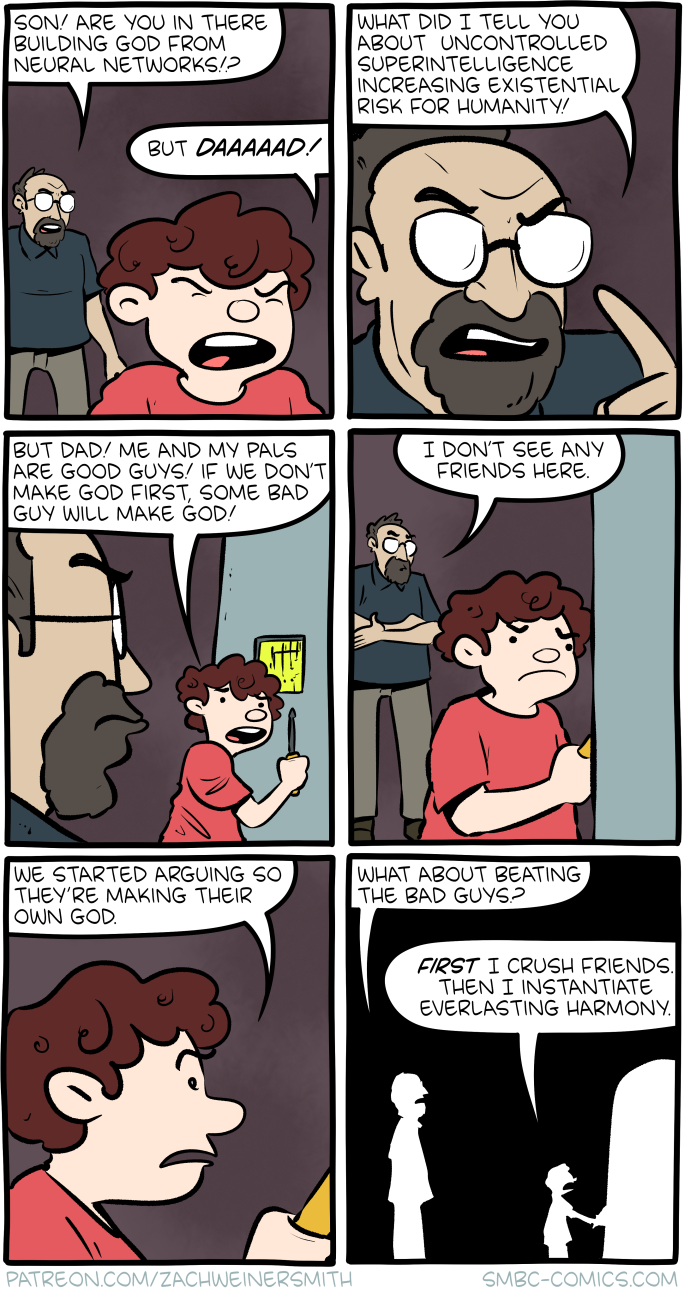
Comic strips